Altitude's Hidden Role in Shifting Endurance Metrics Between Soccer Fixtures and NBA Road Games
Rafael Wagner · Jul 17, 2026

Altitude's Hidden Role in Shifting Endurance Metrics Between Soccer Fixtures and NBA Road Games
High-altitude environments alter oxygen availability and cardiovascular demands during sustained physical activity, and studies document measurable shifts in endurance metrics for athletes competing in soccer fixtures versus NBA road games at elevation. Venues such as those in Denver and certain international soccer locations sit above 1,500 meters, where partial pressure of oxygen drops and forces compensatory increases in heart rate and ventilation rates.
Physiological responses begin within hours of arrival, with researchers noting that hemoglobin saturation declines and muscle oxygen uptake slows during repeated high-intensity efforts. Soccer matches require continuous movement over 90 minutes plus stoppage time, which places steady aerobic load on players, whereas NBA contests feature shorter bursts separated by timeouts and substitutions that allow partial recovery even at altitude.
Physiological Mechanisms at Elevation
Lower air density reduces oxygen molecules per breath, prompting the body to elevate cardiac output and breathing frequency to maintain energy production. Data from exercise physiology labs indicate that VO2 max decreases by approximately 7 to 10 percent for every 1,000 meters gained above sea level, and this reduction compounds when athletes travel from lower elevations without adequate acclimatization time. Soccer players covering 10 to 12 kilometers per match experience cumulative fatigue that registers in declining sprint frequency during the final 30 minutes, while NBA athletes encounter similar decrements in fourth-quarter field goal percentages and defensive closeout speed on back-to-back nights.
Soccer Fixture Patterns at Altitude
League schedules place teams at high-elevation grounds for single fixtures followed by rapid returns to sea-level venues, limiting adaptation windows to 24 or 48 hours. Match data compiled across multiple seasons show visiting sides record fewer successful passes in the final third and reduced distance covered at high speed after the 60-minute mark compared with home performances at lower altitudes. Recovery between fixtures remains critical because repeated exposure without full re-acclimatization extends the period of elevated lactate accumulation, and governing bodies track these trends through standardized GPS and heart-rate monitoring systems.
NBA Road Game Endurance Shifts
NBA travel logistics frequently route teams through multiple cities within a week, and games in Denver create distinct challenges when combined with prior nights at lower elevations. League tracking statistics reveal visiting teams post lower average sprint distances and higher turnover rates in the second half of road contests played above 1,500 meters, with fourth-quarter scoring margins narrowing on average relative to games at sea level. Back-to-back scheduling amplifies these effects because limited rest prevents full restoration of glycogen stores and fluid balance, both of which are further stressed by drier air at altitude.
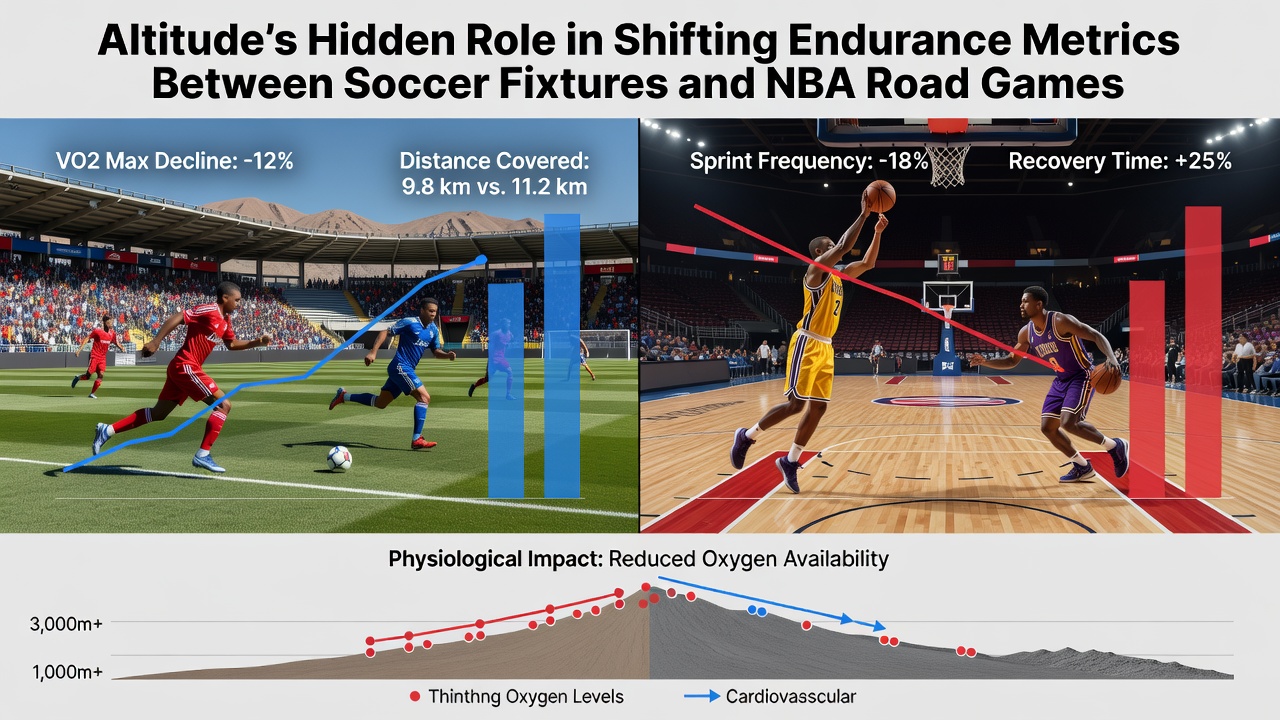
Comparative Endurance Metrics Across Sports
Side-by-side analyses of performance datasets demonstrate that soccer endurance declines appear more uniformly distributed across the full match duration, whereas NBA endurance metrics exhibit sharper drops concentrated in the final six minutes of each half. Researchers attribute the difference to the intermittent nature of basketball, which permits brief anaerobic recovery periods even when oxygen uptake remains impaired. Soccer, by contrast, maintains near-constant movement patterns that leave less margin for partial replenishment of energy systems during play.
July 2026 international soccer windows and NBA summer league schedules introduce additional variables because many athletes arrive from sea-level training camps directly into elevated competition sites. Observers note that pre-match hydration protocols and altitude simulation tents used by some clubs correlate with stabilized heart-rate recovery curves in the opening 15 minutes of play, although full physiological adaptation still requires several days.
Data Collection and Monitoring Approaches
Teams employ wearable devices and optical tracking systems to quantify changes in total distance, high-speed running percentage, and acceleration counts at altitude. According to reports from the National Institutes of Health, longitudinal studies of elite athletes confirm that perceived exertion ratings rise faster under hypoxic conditions even when external workload remains constant. League-wide datasets compiled through 2026 continue to separate altitude-specific effects from travel fatigue by comparing performance at comparable venues with differing elevations.
Coaching staffs adjust substitution patterns and tactical pressing triggers based on real-time biometric feedback, and these adjustments appear more frequently in away fixtures than in home matches at the same sites. The cumulative record shows that endurance metrics normalize within 72 hours after descent to lower elevations, allowing most athletes to regain baseline output before the next sequence of games.
Conclusion
Altitude exerts measurable influence on endurance metrics in both soccer and NBA contexts, yet the expression of those effects varies according to sport-specific movement demands and scheduling density. Continuous tracking through wearable technology and standardized performance databases provides objective records that teams and analysts use to anticipate shifts in output during fixtures played at elevation. As schedules evolve through 2026 and beyond, the integration of altitude-adjusted training protocols remains a documented component of preparation for road contests and away fixtures alike.